

The Modern Woman: 5 Essential Ways to Balance the Mental Load of Modern Womanhood

What is the Mental Load of Women?
The mental load of women is the unspoken expectation of what a woman is responsible for. She remembers birthdays without prompts, keeps on top of payments and deadlines, anticipates what the household will need before anyone asks and still shows up to work focused and composed. What is rarely acknowledged is the invisible infrastructure holding all of this together. Behind the visible achievements sits the mental load of women, a constant background process of planning, anticipating, remembering and emotionally regulating that often goes unseen and unrecognised.
The mental load of women is not simply about completing tasks. It is about carrying responsibility, delegating, and organising them. It is knowing when the car insurance is due. It is writing the shopping list in your head while replying to work messages. It is planning gifts for extended family, reminding everyone of important dates, clearing wardrobes when clothes are outgrown and keeping both yourself and everyone around you organised. It is like we are running a project that we didn’t sign up for.
Alongside this sits emotional labour, the work of managing feelings as well as logistics. It is smoothing over conflict, checking in on relatives, holding space for friends and ensuring the emotional temperature of the household or workplace stays steady.
It is important to recognise that this does not only affect mothers. Women without children often carry the same invisible hats within families, friendships and professional environments. We are the organisers, the planners, and the emotional anchors.
Much of this is learnt behaviour - a social concept that has been modelled for generations. We are not genetically better at anticipating needs or managing households, we have simply become more skilled because the demand has historically been placed on us. The difficulty is that when the mental load does not get carried, the backlash often falls on women.
Since it is invisible, distress about it can be dismissed as overreacting or being overly emotional, and it is difficult to back up or evidence why we feel this way because the weight comes from hundreds of small, unseen things we carry daily that others simply do not witness or fully understand. Many women feel like a backstage crew keeping life running smoothly while the visible performance receives the applause - which almost always leads to burnout.
When attempting to explain the mental load to those around us, women are often met with the question of “Why didn’t you ask for help”. This assumes that delegation is their responsibility, even though you both see the full clothes basket, the empty fridge, the deadlines on the calendar, yet the expectation remains that women will organise the response. Helping is not the same as sharing ownership, and this distinction is where much resentment builds.

What Is the Modern Woman?
The modern woman is frequently described as independent, empowered and self determining. She is encouraged to pursue her career, build financial stability, prioritise wellbeing and choose relationships from a place of desire rather than necessity. She is expected to be confident but caring, driven but present, successful but still emotionally available to everyone around her.
This dual expectation creates tension - women are told they can have it all, yet the systems around them have not fully redistributed responsibility. We ‘can’ be business owners, professionals, and have self-fulfilling lives, just as much as men can, but the difference is that we are burdened with the mental load. Balancing professional growth with the mental load of women requires energy, not just time. It requires mental space to think creatively, lead effectively and feel personally fulfilled. When that space is crowded with invisible responsibilities that are not recognised, the cost becomes burnout.
If left unaddressed, burnout can lead to withdrawal, loss of motivation or emotional numbness, where women continue functioning but feel disconnected from themselves and their lives. Recognising these signs early is important, because recovery often takes far longer than prevention.
For women who feel the mental load has taken its toll, support is available. Inspire You offers free discovery calls to discuss whether therapeutic support is necessary and can benefit you.

5 Essential Ways to Balance the Mental Load of Modern Womanhood
The mental load of women has deep, learnt and systemic roots. It has been modelled across generations and reinforced through culture, workplaces and family dynamics. Unlearning it and shifting societal norms takes time - and in the meantime, we still have to live our lives.
Balancing the mental load is not about accepting a situation that is unfair, nor is it about settling or quietly tolerating. It is about making life more sustainable for ourselves while broader change continues.
We have come up with 5 ways to help balance the load: learn, stop, simplify, start and evaluate.
1. Learn the Language of the Load
One of the most powerful starting points is understanding what you are experiencing and being able to articulate it. When we learn how to explain the mental load of women to those around us, we begin to externalise the pressure rather than internalise it as something we are getting wrong or simply need to push through.
When you can clearly explain the mental load to those around you, whether that is a husband, partner, colleague or family member, the dialogue becomes more constructive. Instead of saying you feel stressed, you can describe the constant background planning, anticipating and decision making that is exhausting you.
Listening to podcasts, reading articles and hearing other women describe their experience can be deeply validating. If you have kids, recommend listening to ‘The Mental Load’ podcast by Katlynn Pyatt and Angie Cantrell, which is particularly relatable for mothers and women managing family life, exploring the invisible labour within households and the cognitive and emotional responsibility that often sits behind parenting and partnerships.
2. Stop Carrying What Is Not Yours
Many of us continue tasks out of habit rather than genuine necessity, and over time we begin to assume ownership over entire categories of responsibility without ever consciously choosing to do so. We worry that if we do not oversee something ourselves it will not get done properly, or that standards will slip, and this can lead us to become increasingly rigid because we feel personally accountable for the outcome of everything.
Stopping, however, does not mean abandoning what matters. It means recognising and relinquishing learnt responsibility that is not solely ours to carry. It involves stepping back and allowing shared ownership to develop, even if that feels uncomfortable at first. If something does not get done after expectations have been clearly communicated, that outcome is not automatically your fault, because adults are responsible for their own contributions within shared spaces and relationships.
There are also responsibilities that can be consciously released altogether. This is not because those things are unimportant, but because your wellbeing is more important. Many women become so overwhelmed with getting everything done that they stop questioning whether everything truly needs to be done to that standard, within that timeframe or by them personally. Choosing to prioritise your own wellbeing is not selfish, it is necessary in order to create a more sustainable and balanced way of living.
3. Simplify What Needs Doing

While not everything can be stopped, much can be simplified, and when the mental load of women is high, reducing complexity becomes essential for protecting cognitive and emotional energy.
Food is often one of the biggest contributors to decision fatigue. Planning what you are eating, what others are eating and ensuring it aligns with health, time and budget can become a constant background task. Introducing a simple weekly plan, rotating a small number of reliable meals or occasionally outsourcing preparation can significantly reduce daily pressure. For those local to Brighton, we partner with local providers that offer healthy meal options for families and individuals, which can remove planning and cooking stress when capacity is low.
Beyond food, simplification can touch almost every area of life. Streamlining wardrobes reduces daily micro decisions and preserves mental clarity. Creating repeatable routines for mornings or evenings removes the need to constantly rethink what happens next. Shared digital calendars and visible task lists externalise information so it is not stored entirely in your head, reducing the invisible cognitive load.
Simplifying is not about lowering standards or disengaging from life. It is about consciously designing systems that reduce unnecessary decision making so that your energy can be directed towards work, relationships and rest rather than constant administration.
4. Start Investing in Sustainable Self Care
Self care does not need to be expensive or elaborate, but it does need to be intentional. When emotional labour has been carried for years, deeper support can be helpful, and coaching is often a valuable investment. Through Inspire You there are different options depending on what a woman needs, including therapeutic coaching for lifestyle and emotional support, business coaching for those navigating work life balance for women, and app-based support through CoreSeven for lower intensity, self-paced guidance.
Alongside structured support, there are many accessible ways to reduce overwhelm in women without financial pressure. Regular walks, time in nature and simple movement such as YouTube yoga sessions can calm the nervous system and improve mental clarity. Journalling creates space to process thoughts that would otherwise continue looping in the background, while breathwork or short moments of stillness between tasks can regulate stress responses that build from carrying the mental load of women.
Protecting small pockets of screen-free time, setting clearer boundaries around availability and creating consistent daily rhythms can also restore energy. These practices may seem modest, but when done regularly they build resilience and reduce the risk of signs of burnout in women escalating. Prioritising your own wellbeing is not indulgent, it is a necessary part of sustaining both ambition and care for others.
5. Evaluate and Renegotiate Relationships
People are capable of change, and they should at the very least be willing to listen when the mental load and its impact are clearly communicated. If you have taken the time to explain your experience to those around you, and it continues to be dismissed or minimised, that response is important information rather than something to overlook.
Shared life requires shared ownership rather than occasional assistance. This applies within partnerships, but also within workplaces where women may carry disproportionate emotional labour, and within friendships or family dynamics where reciprocity may feel imbalanced.
If someone repeatedly refuses to engage in conversation or meaningful change, it may become necessary to evaluate how much access they have to your time and energy. Lightening the load can sometimes involve adjusting expectations, strengthening boundaries or redefining proximity in order to protect your wellbeing.
Protecting your energy is not an overreaction, it is a strategic decision that supports sustainable work life balance for women and allows you to show up more fully in the areas of life that matter most.
The Path Forward
The mental load of women did not appear overnight, and it will not disappear overnight either. It is rooted in deep systemic, cultural and generational conditioning that has shaped how women show up in homes, workplaces and relationships for decades. Shifting those norms will take time, collective awareness and ongoing societal change. But while that wider work continues, we are not powerless.
We can begin by working on what sits within our own control. Learning how to balance the mental load is not about fixing everything at once, nor is it about accepting an unfair status quo. It is about making life more sustainable in the present while contributing to longer term change. Every conversation we have, every boundary we set and every expectation we challenge helps reshape the narrative.
At Inspire You, this is the work we support women to do every day. Our approach is rooted in therapeutic and evidence-based practice, recognising that sustainable change rarely comes from surface level coaching alone. We work with women to explore the beliefs, conditioning and emotional patterns that sit beneath burnout, overwhelm and the mental load, helping them reconnect with who they are beyond the roles they carry.
For International Women’s Day 2026, we are giving away a free 30-minute power session with a business coach for a female business owner or professional.
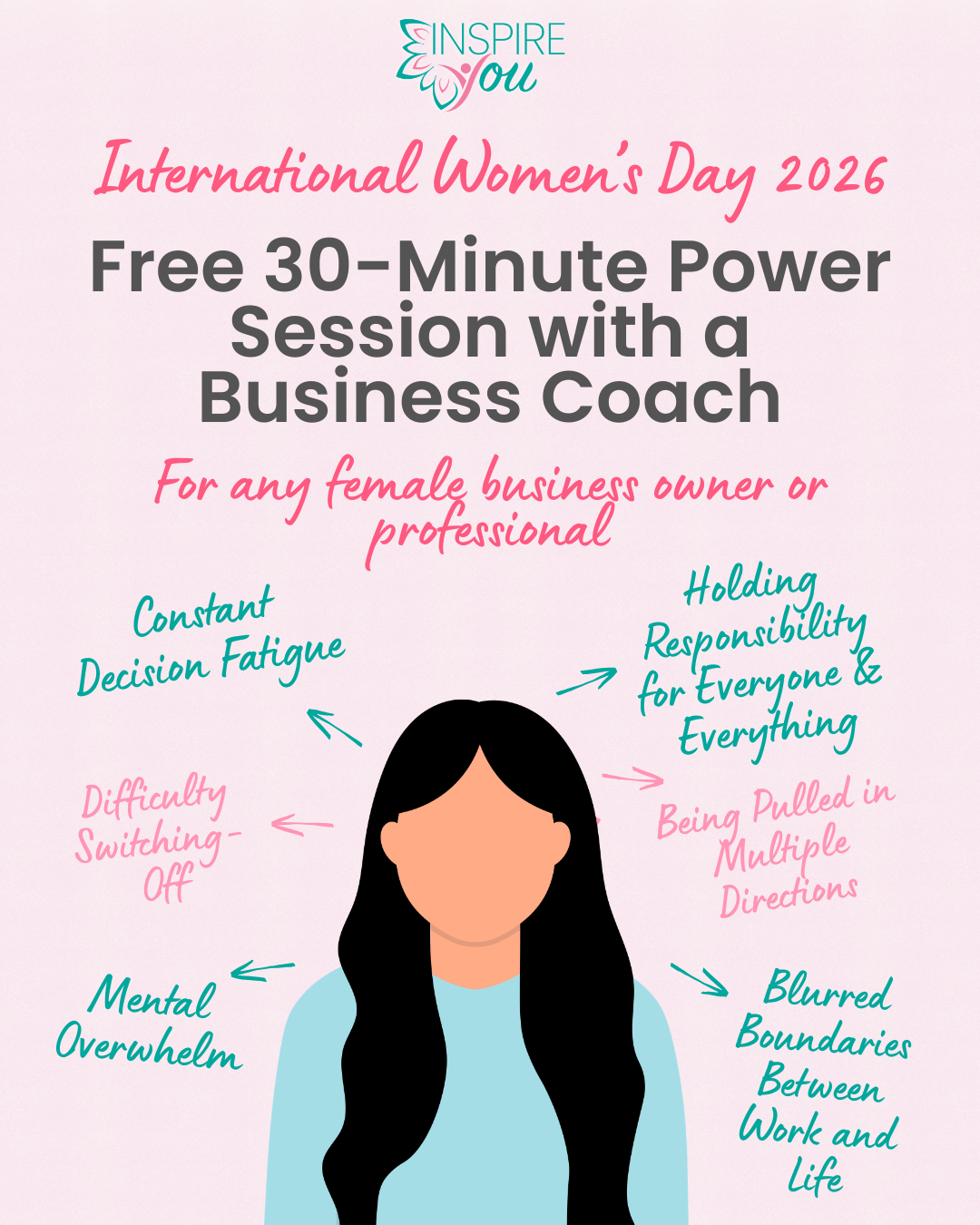
The session will be delivered by Claire Elmes, founder of Inspire You Wellbeing, who built her award-winning wellbeing business while raising two children and understands first-hand the pressures of balancing leadership, family life and personal wellbeing.
In this focused session you will:
• Identify where your mental load is currently sitting
• Analyse what is holding you back
• Leave with three practical shifts to enable your growth
It is free to enter and the winner will be picked at random and contacted by email on the 16th of March. The deadline to enter is Sunday 15th of March.
This is a guest article by Inspire You Wellbeing.