

The Ultimate Guide to Cash Flow Management
We’ve all had that month. A good one on paper, with plenty of work, invoices sent and the numbers all pointing in the right direction. Yet, somehow, the account is nearly empty, a big bill is due on Friday, and you're left wondering where all the money’s gone. If you've ever felt profitable and skint at the same time, you already know the strange, stressful gap that is cash flow.
Cash flow is the single biggest thing that trips small businesses up. It's why a business can look perfectly healthy and still lurch from a brilliant month straight into a month of quiet panic.
Here's the reassuring part: cash flow problems are largely predictable, and mostly preventable. Once you can see money moving in and out clearly, you can spot a squeeze coming weeks before it lands while you still have time to do something about it.
This guide covers what cash flow really is, how to know your own numbers, and how to build a simple buffer so a quiet month is never a crisis.

What the Business Connections community keeps telling us
Across our Business Connections events and online spaces, one worry comes up more than almost any other. It isn't profit, and it isn't pricing. It's timing. "I know I'm making money, but why does it always feel tight?"
Two things sit behind that feeling, and understanding them is what turns cash flow from a source of dread into something you can actually manage.
Profit and cash flow are not the same thing
It's the distinction that catches almost everyone out, so let's be clear about it.
● Profit is what's left when you take your costs away from your income over a period of time.
● Cash flow is the timing of money moving in and out of your account.
You can be profitable on paper and still run out of cash. In any given week, the two have surprisingly little to do with each other.
Imagine this. You have a good month on paper: £4,200 invoiced, with which you can cover all costs and have a healthy margin. But two of those invoices are on 30-day terms, and your software subscription and own pay go out this week. On paper, you’re having a great month, but your account is short. It’s not that you aren’t making money, but because it hasn't arrived yet.
That gap, between money earned and money actually in the bank, is where the stress lives.
Your landlord, your software provider and your own household don't wait for a client's invoice to clear. That’s why managing cash flow is really about managing timing.
Know your cash runway
If there's one number worth knowing off by heart, it's your cash runway: how many months you could keep the business going if the money coming in stopped tomorrow.
The maths is refreshingly simple. Take the cash you have available and divide it by your essential monthly outgoings. If you've got £6,000 in the account and your must-pay costs come to £2,000 a month, you have three months of runway. That's it.
Knowing the number does something quietly powerful: it turns a vague, 2am sort of dread into a concrete figure you can plan around. A short runway tells you to build a buffer before you take on that new cost. A comfortable one tells you that you can breathe, and maybe say yes to the thing you've been putting off.
Check it at the start of each month and it soon becomes second nature.
Build a buffer: the three-pot system
The most reliable way to smooth out lumpy income is almost embarrassingly simple: stop keeping all your money in one place.
The idea is to split what comes in across three pots:
● Operating: The money that runs the business day to day: software, stock, subscriptions, your own pay.
● Tax: A slice of every payment that was never really yours to spend.
● Profit: Your buffer, your reward and the cushion that carries you through the quiet months.
The trick is to divide money into these pots as it lands, not at the end of the month once it's already been spent. Do it consistently and the feast-or-famine cycle starts to soften: the quiet months are already covered, because the good months quietly paid for them.
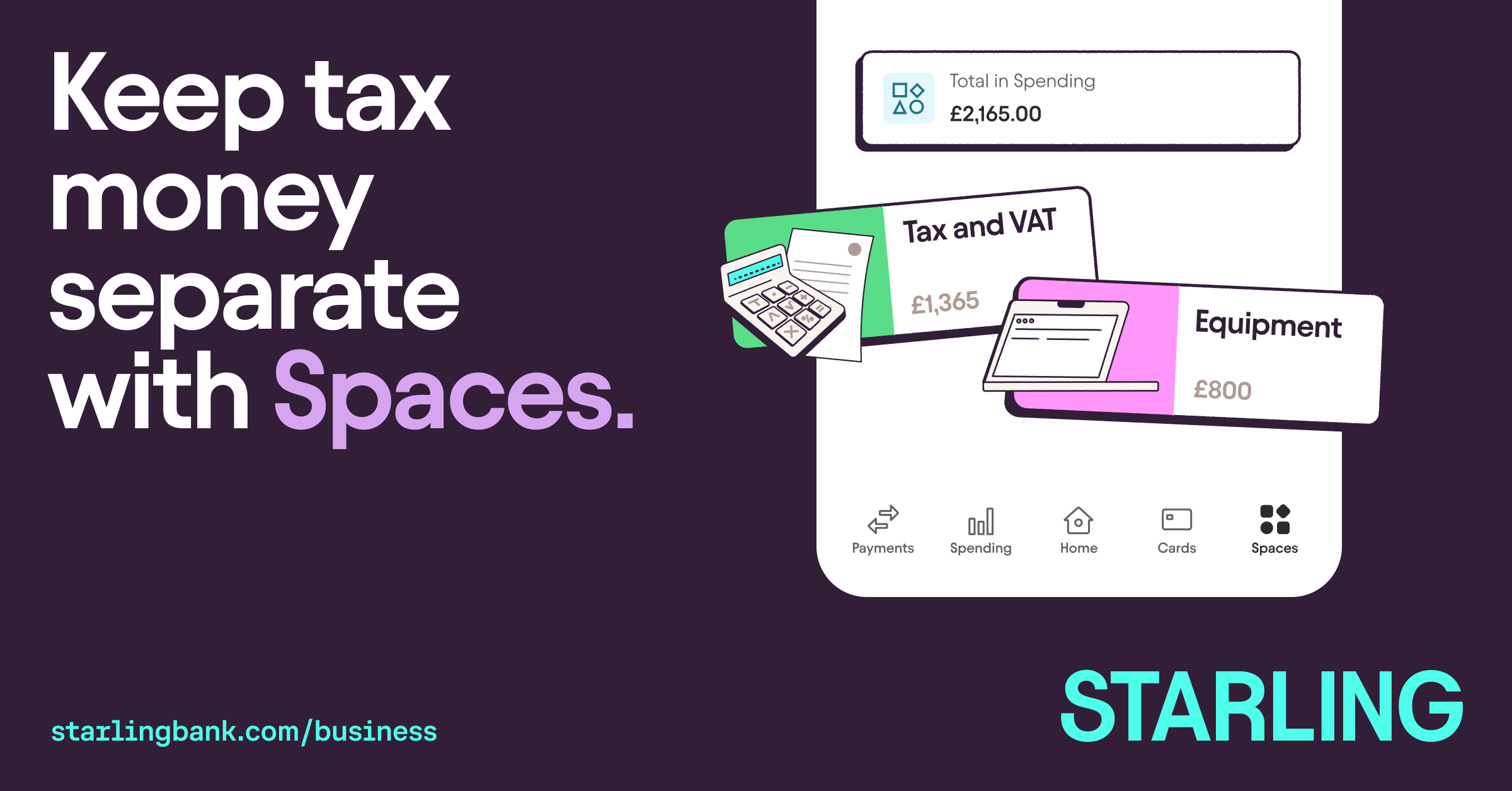
Starling: Spaces
Spaces are virtual pockets of money that sit inside your account, kept separate from your main balance. Think of them as digital jars. Setting up a Space each for Operating, Tax and Profit turns the three-pot system from a nice idea into something you actually do: every time you're paid, move a slice into each.
It all lives in one app, with a real-time balance and instant notifications the moment money moves, so you always know your true position at a glance. Not just what's in the account, but what's genuinely free to spend. Like the rest of your Starling account, funds held in Spaces are covered by the FSCS.
Getting paid on time and what to do when you're not
Here's an uncomfortable truth: some of your cash-flow problems won't be yours at all. They'll be someone else's late payment. Waiting to be paid is one of the most common causes of a cash crunch for small businesses, so it's worth being deliberate about.
You can reduce late payments more than you might think.
● Set clear payment terms up front, so there's no ambiguity.
● Send your invoice the moment the work is done, not weeks later when you finally get to the admin.
● Ask for a deposit on larger jobs.
● Make it genuinely easy for people to pay you. The fewer the barriers, the faster the money.
When a payment is late anyway, a calm, systematic chase almost always works better than an awkward silence: a friendly reminder the day it's due, a firmer one a week on. And know your rights. You're generally entitled to charge interest on overdue business invoices, which is worth stating in your terms even if you rarely need to enforce it.
Starling: Bills Manager, Invoicing & Tap to Pay
Cash flow is about money coming in faster than it goes out, and Starling helps on both sides.
● Bills Manager puts your regular outgoings into a dedicated ‘Space’, separating your money for bills from your everyday spending.
● Bill Change Alerts warn you when a payment is about to rise, so nothing blindsides your budget.
● Free Invoicing lets you raise and track invoices from your phone, so you can see at a glance what's still outstanding.
● Tap to Pay lets you take payment on the spot, with no card machine required.
Putting it into practice: your monthly cash-flow check
Fifteen minutes at the start of each month is all this takes:
1. Work out your runway. Cash available divided by essential monthly outgoings. Note whether it's gone up or down since last month.
2. Check your pots are funded. Operating, Tax and Profit: is each holding what it should? 3. Chase what's owed. Review outstanding invoices and follow up on anything overdue before it becomes a problem.
4. Look ahead. Spot any big bills or quiet periods coming in the next month or two, and set money aside now while you can.
Do this consistently and cash flow stops being something that happens to you. It becomes something you can see coming — and steer.
What cash flow taught me the hard way

Ready to get on top of your cash flow?
A Starling Business Account is free to open, with no monthly fees. You get real-time visibility of every transaction, Spaces to build your three-pot buffer, Bills Manager to keep outgoings under control, and free Invoicing to help you get paid faster, all in one app.
Disclaimer: This article contains general information only and is not intended to address your particular circumstances or requirements. This information does not constitute advice in any way and should not be taken as such. If you have questions about your specific circumstances or require financial advice, please speak to an independent financial advisor.